
Every strategic or operational decision carries a degree of uncertainty. To make informed choices, organizations must assess whether the associated risks fall within acceptable boundaries.
This evaluation relies on two fundamental parameters: risk appetite and risk tolerance
These concepts, central to both NIST guidance and international standards like ISO 31000 and ISO 27005, ensure that risk-based decisions remain consistent, transparent, and aligned with enterprise objectives.
Risk Appetite
Risk appetite represents the amount and type of risk an organization is willing to accept in pursuit of its objectives. It sets the tone for risk management and shapes decision-making at every level.
Defining risk appetite requires understanding:
strategic goals,
stakeholder expectations,
regulatory constraints,
and the organization’s capacity to manage and absorb risks.
It is the broad guidance from leadership that informs all subsequent risk evaluations.
Risk Tolerance
Once risk appetite is defined, organizations establish risk tolerance, which specifies the acceptable level of variation when pursuing particular objectives.
Risk tolerance provides concrete thresholds or limits within which teams must operate—ensuring decisions remain consistent, predictable, and justified.
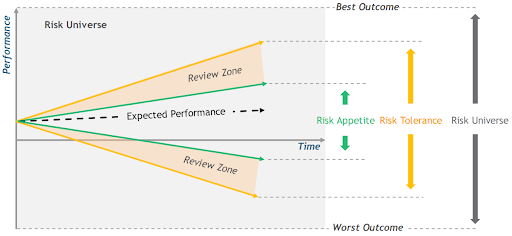
Source NIST SP 800-161r1-upd1 Cybersecurity Supply Chain Risk Management Practices for Systems and Organizations, p. 268.
Distinguishing Risk Appetite and Risk Tolerance
While closely related, these two concepts serve different purposes:
Risk appetite sets the overarching direction.
Risk tolerance statements define the specific application of that direction.
Risk tolerance statements are always more specific and actionable than risk appetite statements.
Together, they:
establish clear risk limits,
help communicate risk expectations,
and improve the focus of risk management efforts.
The definition of these risk parameters places the enterprise in a better position to identify, prioritize, treat, and monitor risks that may lead to unacceptable loss.
Importantly, risk tolerance should always stay within the boundaries established by senior leadership and within the parameters of and informed by legal and regulatory requirements.
Example of Risk Appetite and Risk Tolerance Statements
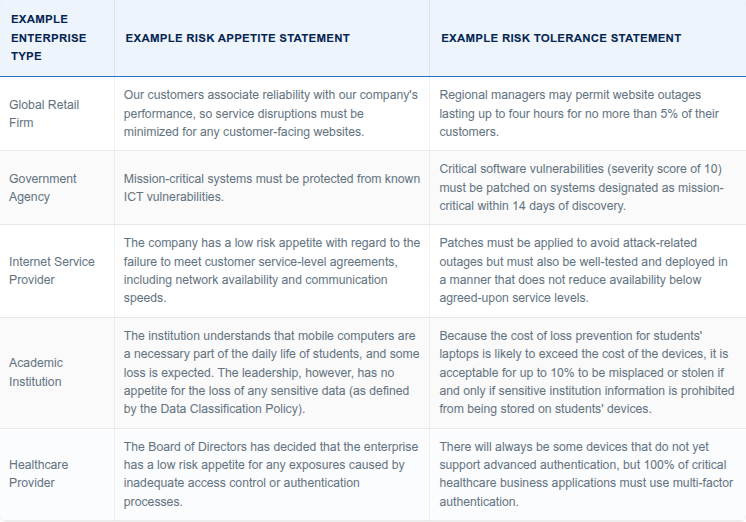
Source NIST SP 800-221, Enterprise Impact of Information and Communications Technology Risk. Governing and Managing ICT Risk Programs Within an Enterprise Risk Portfolio, p. 20-21.
Conclusion
In conclusion, a clearly defined risk appetite and well-established risk tolerances transform risk management into a strategic advantage. Aligned with ISO 31000 and ISO 27005, they support consistent decision-making, effective prioritization, and rapid adaptation to evolving threats. Ultimately, they become powerful drivers of resilience and long-term organizational performance.
Integrated into a practical platform like CSFaaS, these principles give organizations a strong foundation to manage cybersecurity risks with confidence, making it easier to structure, automate, and accelerate their cybersecurity journey.